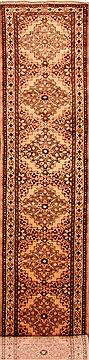
Rudbar or Roodbar is a small village in Northern Iran's Gilan province. It is situated just south of Rasht. Rudbar produces a small amount of handmade Persian rugs. Although the Rudbar is a tribal style rug made in the northern subtropical area that it is, the quality is very high and much higher than the quality of the rugs made in other regions of Northern Iran. Rudbar usually makes geometric styles and floral patterns are rarely made. Most Rudbar carpets consist of octagonal compartments arranged in a neat allover manner. Vase elements, which is a very ancient Persian rug motif, is also portrayed in most rugs from this small village. The people in and around Rudbar are predominantly semi-nomadic Turco-Persians and/or Kurds. These are the people that weave these rugs in a very primitive and simple manner. The colors in a Rudbar rug may be any combination of reds, taupe, and many shades of blue. An authentic Rudbar is a great way to add some tribal warmth and hospitality to your floor.
The Northern part of Iran, including the provinces of Gilan, Zanjan, and Mazandaran is very rich in history. There are some strong traces of Turkish and Kurdish influence seen in these nomadic and/or semi-nomadic people, but they are mostly of Persian origin. Turkish and Mogul tribes who are descendants of the Mongolians (led by Chengis Khan) who invaded the country in the 13th century have been living in this region for many centuries. The province of Zanjan has a higher Kurdish population and Gilan has a higher Persian nomadic population. These peaceful people are documented to have been weaving rugs for over 3000 years. They have a migratory lifestyle and almost all the women, along with most of the men, have the incredible talent of rug weaving. In some cases, the rug weaving is the family's main source of income. These provinces of Iran continued to weave rugs even in the harshest conditions and they kept this truly magnificent art alive as much as they could.
The people of the northern regions of Iran have a long history of weaving durable rugs. The tribal pieces made here are always wool pile. The foundation of the rugs can either be cotton or goat hair. The coloring is mainly done with the use of natural vegetable dyes. The Persian asymmetrical knot is used much more often than the symmetrical Turkish double knot. The Persian knot is always more precise and much finer. The construction of these rugs is very difficult for these people because they live nomadically, far away from the conveniences of modern technology. They make their own looms, which are placed horizantally on the ground, and easily dismantled and transportable. The pile is usually thick and soft. A very durable floor piece, the rugs of northern Iran last a very long time.




Be the first to know about new designs and
exclusive offers, and get up to
10% OFF
your first purchase
Rugman since 1998 | The first and oldest online rug store
You can unsubscribe with a single click. We value your privacy; click here for more info.
You have one more step to join
Rugman Insider Club.
A coupon code will be emailed to you.
Please check your email and just
click the green “Confirm Subscription” button.


 Rectangle
 Round
Round
 Runner
 Square